Highlights: WWII German C G Haenel MKb.42(H) machine gun, $270,600, and MG-34 machine gun, $150,000; Model 1902 American Eagle Cartridge Counter Luger, $116,850; Japanese Type 100 machine gun, $110,700
DENVER, Pa. – A rare and desirable German World War II C G Haenel MKb.42(H) machine gun – the very first Sturmgewehr – soared to $270,600, and an equally hard-to-find German World War II MG-34 machine gun with matching bolt, barrel and amnesty form hit the mark for $150,000 in Morphy’s big Firearms & Militaria auction held September 15-17. The sale featured nearly 1,200 lots of antique and collectible firearms and grossed $6.4 million.
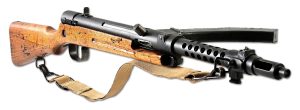
The C G Haenel MKb.42(H) machine gun was the overall top lot of the auction, with the $270,600 selling price more than doubling its $120,000 high estimate. The weapon was a select-fire rifle that used an intermediate-size cartridge, able to fulfill many combat roles. This was an important historical development, as it meant soldiers could carry more readily-available ammunition and could quickly change between aimed fire and suppressing fire. Nearly all of the 8,000-12,000 units produced from 1942-43 were fielded to Russia, which is why so few are found in the United States. The one in the auction had a near-excellent original finish, with clean and attractive wood.
An Amnesty registered German MG-34 machine gun with matching visible numbers (including Bakelite butt, barrel and bolt) came from a collector with great foresight who acquired fabulous German WWII machine gun specimens more than 20 years ago. He was so forward-thinking that he had a noted machine gun dealer acquire and match three sets of correct barrels and bolts for it. Of all the MG-34 guns Morphy’s cataloger has handled over the last 40+ years, very few have had originally-matching barrels and bolts. Also, the gun was in a condition that every advanced German machine gun collector desires. The $150,000 selling price was exactly twice the $75,000 high estimate.
A DWM Model 1902 American Eagle Cartridge Counter Luger, representing one of the rarest, most desirable early semi-automatic pistols associated with United States military trials, sold within estimate for $116,850. Manufactured during a time when the US Army was evaluating self-loading handguns to replace revolvers, these Lugers were among the most advanced and refined sidearms of the era. This weapon – Serial Number 22432 – was one of about 50 pistols made for the US Board of Ordnance during the 1902–1903 trials program and was once part of the prestigious Dr Geoffrey Sturgess collection. It was extensively documented in The Borchardt & Luger Automatic Pistols by Gortz and Sturgess.
An extremely desirable Japanese Type 100 machine gun, perhaps the most sought-after of all the Japanese machine gun models of World War II, finished above high estimate at $110,000. The gun was manufactured by Nagoya Arsenal and included one original magazine, a reproduction sling and a steel buttplate. Fewer than 6,000 of these Type 100 weapons were manufactured, and there aren’t many specimens listed in the National Firearms Act registry. Interest in Japanese machine guns is on the rise, especially now that suitable modern ammunition is obtainable.
An important prototype (or experimental) Colt 1851 Navy Conversion Single Action Revolver with a 7-½ inch octagonal barrel, brass pin front sight and early New York City address with dashes, changed hands within estimate, for $56,580. This .38 CF caliber revolver was pictured on Page 112 of The William M Locke Collection by Frank Sellers and is almost certainly a one-of-a-kind prototype for the later factory conversions of the ’51 Navy and others that followed. The winning bidder saw this for what it was: an exceptional and exceedingly rare gun in great condition and a wonderful piece of Colt history.
A David McKay Brown (McKay Brown Gunmakers) 12 bore over/under shotgun with accessories and case knocked down $45,600, as was expected. It was a fine modern gun by a noted Scottish maker that has been keeping the Dickson round-action tradition alive. The weapon had 28-inch demi-bloc barrels mounted with a narrow, flat matted rib. The action was engraved with nearly full coverage of well-cut open shaded scroll. It was in fine shape, showing limited field use. The bores were excellent, the action tight, and the walnut and black morocco leather case was exceptional.
A rare, large, untouched engraved Havana map powder horn dated July 7, 1763 and decorated with polychrome colors brought $43,200, easily besting the $30,000 high estimate. The horn was previously unknown and recently came out of a family in New Jersey, where it was passed down for several generations. Havana map horns are quite rare, and only a handful are known to exist. This horn was 13-½ inches across the bow and 18 inches along the curved body. The professionally engraved plan of Havana included “Moro” (for Moro Castle), Shepards Battery, New Store, Reguler, Ponto, North Port, and Fuza. Polychrome red was used in addition to black pigment. Five detailed warships were also engraved.
A 2nd Model Confederate Morse single-shot carbine, manufactured at the State Military Works in Greenville, South Carolina, and chambered for its proprietary .50 Morse cartridge, rang up $28,800 against a $15,000 high estimate. The serial number was located on the underside of the frame forward of the trigger guard, and the 20-inch-long round barrel had a diminutive drift adjustable front blade sight with dovetailed rear sight. The overall length was 39½ inches. These rare little carbines are hardly ever encountered and seldom appear for public sale. This one was a real beauty.
A Heym .470 Nitro Express side-by-side double rifle breezed past the $18,000 high estimate to garner $28,290. The shoe lump barrels were fit with a brass bead front sight dovetailed vertically into an island sweated to the muzzle with flip-up moon sight and smooth ramp. The half-length rib with rounded point was matted across the top with an open vignette that read, “PAUL JAEGER INC. GRAND JUNCTION, TN.” The rifle was embellished with acanthus scrollwork and linework edges. This was a well-handling double rifle in one of the all-time classic dangerous-game chamberings.
An Izumi no Kami Owari Nobuie katana with mounts and NBTHK papers, 38¼ inches long, sold within estimate for $11,070. While Nobuie originally signed his swords with a different character, he changed his signature after receiving the title “Izumi no Kami,” which was granted by the Imperial Court in recognition of his craftsmanship. This sword was signed Izumi no Kami Fujiwara Nobuie and utilized the second character. It had a powerful gunome midare hamon and was housed in a refined set of mounts. This was a superb ubu (uncut) sword by a highly skilled maker and was already mounted and papered.
To discuss consigning to a future Firearms & Militaria Auction, or other auction hosted by Morphy’s, call Dan Morphy at 877-968-8880 or email info@morphyauctions.com. All enquiries are kept strictly confidential, and there is never an obligation to consign. Online: www.morphyauctions.com.
CAPTIONS:
All images courtesy of Morphy Auctions
1006 –
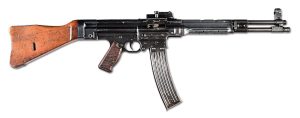
Rare World War II German C G Haenel MKb.42(H) machine gun – the very first Sturmgewehr – a select-fire rifle that used an intermediate-size cartridge able to fulfill many combat roles. Sold for $270,600
1010 –
Japanese Type 100 machine gun, perhaps the most sought-after of all the Japanese machine gun models of World War II, manufactured by Nagoya Arsenal, including one original magazine. Sold for $110,700
1011 –
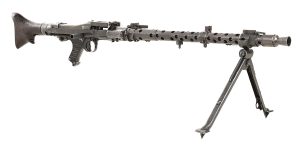
German amnesty-registered WWII MG-34 machine gun with matching visible numbers (including Bakelite butt, barrel and bolt), in a condition advanced German machine gun collectors desire. Sold for $150,000
1216 –
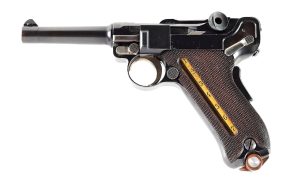
DWM Model 1902 American Eagle Cartridge Counter Luger, representing one of the rarest, most desirable early semi-automatic pistols associated with United States military trials. Sold for $116,850
1273 –
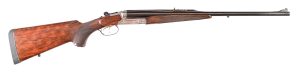
Heym .470 Nitro Express side-by-side double rifle, embellished with acanthus scrollwork and linework edges, and with a vignette that read, “PAUL JAEGER INC. GRAND JUNCTION, TN.” Sold for $28,290
1274 –
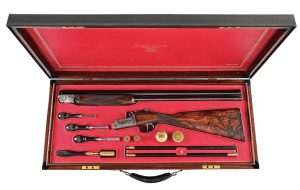
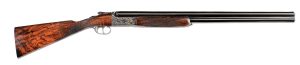
David McKay Brown 12 bore over/under shotgun with accessories and case, a fine modern gun from a noted Scottish firm that has been keeping the Dickson round-action tradition alive. Sold for $45,600
1308 –
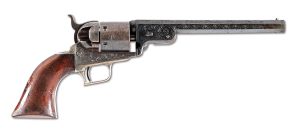
Important prototype (or experimental) Colt 1851 Navy conversion single-action revolver with 7-½ inch octagonal barrel, brass pin front sight and early New York City address with dashes. Sold for $56,580
1402 –

Izumi no Kami Owari Nobuie katana with mounts and NBTHK papers, 38¼ inches long, a superb ubu (uncut) sword by a highly skilled maker that was already mounted and papered. Sold for $11,070
2061 –

Rare, untouched and large engraved Havana map powder horn dated July 7, 1763, decorated with polychrome colors, 13-½ inches across the bow and 18 inches along the curved body. Sold for $43,200
2109 –
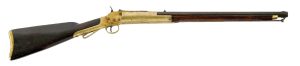
2nd Model Confederate Morse single-shot carbine, manufactured at the State Military Works in Greenville, South Carolina, and chambered for its proprietary .50 Morse cartridge. Sold for $28,800
The Latest Auctions & Events
New auctions are posted frequently. Check back to see what you can add to your collection.